UPDATE:
On October 15, 2009, U.S. District Court Judge Saundra B. Armstrong dismissed the lawsuit. On November 5, 2009, the City of Kivalina appealed Judge Armstrong’s decision to the U.S. Court of Appeals for the Ninth Circuit. On March 11, 2010, Kivalina’s team of lawyers filed the community’s opening brief. On September 15, 2010, we filed our response to the arguments of the oil, energy, and coal company defendants’ arguments. We expect oral argument in the summer of 2011.
from: http://www.crpe-ej.org/crpe/index.php?option=com_content&view=article&id=103&Itemid=101
This is a real David and Goliath story — the Alaskan village of Kivalina vs. ExxonMobil, et al, A tiny Native American village against some of the biggest energy companies in the world.
You probably have not heard of this case. Yet some law firms think it is the most dangerous case in America today. You may not have heard of this case because the major news media is charged with being an un-named co-defendant. So news organizations might not want to call attention to themselves for having helped Exxon in a conspiracy to suppress global warming news and science. So it is possible that mainstream news coverage of this story would be lacking.
“I see disaster. I see catastrophe. Worse, I see lawyers.” - Woody Allen
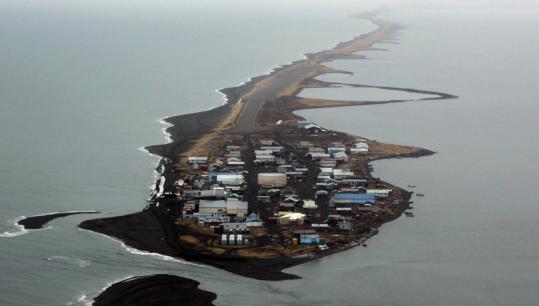
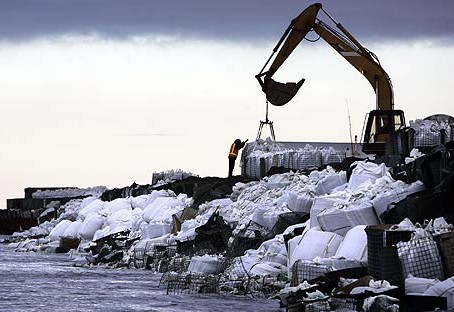
It started in Alaska. The small Native Village of Kivalina, situated on a small spit of land only a few feet above sea level was damaged by rising waters storm surges. Storm surges have reached the edge of the village because the ice was gone; normally a thick boundary of ice prevented the sea from doing damage. With global warming, the greatest amount of heating increase is up in the polar regions. Already they have more than 6 degrees C of increase - enough to melt ice, and destabilize the climate in ways that make storms more severe. About to be swallowed by the sea, so Kivalina decided to sue 24 carbon fuel energy companies that heavily contributed to global warming.
Their lawsuit is starting to get plenty of attention. DemocracyNow interviews the plaintiff Attorney Stephen Susman. The case is now before the Federal Courts - the oil companies call this the
“The Most Dangerous Litigation in America”
The Kivalina suit asks for $400 million in monetary damages. Kivalina lawyers are filing a public nuisance action for “defendant’s contributions to global warming through emissions of large quantities of greenhouse gases”
Perhaps just as important, the Kivalina suit charges fossil fuel companies with civil conspiracy “intended to suppress the knowledge of the link between greenhouse gas emissions and global warming, thereby furthering the defendants’ abilities to contribute to global warming.” And they are asking for damages from un-named co-conspirators - that could be PR agencies, think-tanks or media outlets — any media with a big coal/oil relationship - possibly even those who made and delivered advertising.
This case is most interesting because the science is pretty clear, it is mostly CO2 that caused and still causes increased global warming. And that CO2 comes almost entirely from burning carbon fuels - oil, gas and coal. So Kivalina has named the correct defendants. And furthermore, there was an Exxon conspiracy to suppress the science and influence public opinion. Even today, the Sunday morning news shows are all sponsored by ExxonMobil While this does not mean bias, it does mean news media might be carefully selective about handling global warming news stories. Futher, numerous think tanks and web sites are heavily subsidized by Exxon and other carbon fuel companies.
One legal analysis from an Oil Industry viewpoint summarizes the potential business exposure of this case:
“Every industry trade group, business association, and public policy organization that expresses any opinion, cites any scientific evidence, or dares to question the assumptions of the Al Gore-driven global warming model is part of the conspiracy. As such, the company-defendants and the organizations are potentially liable. Legally liable. Subject to damage awards. Subject to court-ordered cease-and-desist orders. Subject to court-enforced silence.” - from http://www.legalreforminthenews.com
However this case resolves, it will set a huge precedent. If sustained, then more cases will be filed leading to huge damage awards and substantially halted CO2 output. If it fails, then there will be no constraining CO2 output and the heat is on full blast. Kivalina is just one of many new court cases addressing global warming directly. Exxon might prefer to settle the case and avoid prescedent - but certainly this could be a very common litigation.
Some climate science and politics blogs have been discussing global warming denialism and skepticism. They note the well funded and coordinated attacks and strident denials of global warming science. The Kivalina suit may legally force the revelation of the full extent of global warming denial. It is clearly a well-funded business tactic. And like the conspiracy to delay tobacco legislation, the energy industry conspiracy against science has been similarly effective.
By comparison, if we look to England, Mexico, Canada, Australia, even Japan - all are way ahead of the US in the public discussion and scientific acceptance of climate change. The Kivalina suit may air the dirty secret: cultivating ignorance is just business. Energy companies were working to avoid any constraints to their business. Something they can do, unless the courts rule it a public nuissance.
Taken from the Kivalina v. ExxonMobil filing
Kivalina v. ExxonMobil filed complaint
p.69
The Conspiracy Defendants have engaged in agreements to participate in the
intentional creation, contribution to and/or maintenance of a public nuisance, global warming.
The Conspiracy Defendants participated and/or continue to participate in an agreement with
each other to mislead the public with respect to the science of global warming and to delay
public awareness of the issue so that they could continue contributing to, maintaining and/or
creating the nuisance without demands from the public that they change their behavior as a
condition of further buying their products. At all times the Conspiracy Defendants were
concerned that the public would become concerned by global warming and that the growing
concern would force a change in the Conspiracy Defendants behavior which would be costly.
Delaying these costs was the major objective of the conspiracies described herein.
270. The Conspiracy Defendants have committed overt acts in furtherance of their
agreements. The Conspiracy Defendants have participated in an agreement with each other to mislead the public with respect to the science of global warming, either individually or through their various industry fronts or trade associations, and have included overt acts that furthered their intentional creation, contribution to and/or maintenance of a public nuisance, global warming…
RELIEF REQUESTED
Plaintiffs request that this Court:
1. Hold each defendant jointly and severally liable for creating, contributing to, and maintaining a public nuisance;
2. Hold the Conspiracy Defendants jointly and severally liable for civil conspiracy;
3. Hold each defendant jointly and severally liable for concert of action;
4. Award monetary damages on the basis of joint and several liability according to proof;
5. Enter a declaratory judgment for such future monetary expenses and damages as may
be incurred by Plaintiffs in connection with the nuisance of global warming;
6. Award attorneys fees;
7. Award costs and expenses; and
8. Award such other relief as this Court deems just and proper.
DEMAND FOR JURY TRIAL
The case was filed in Feb 2008. I will try to update this page or link to news as it comes forth.
Some links for more information:
Readers Digest has a fine report on Kivalina, Alaska: A Melting Village
http://www.rd.com/your-america-inspiring-people-and-stories/kivalina-alaska-a-melting-village-/article98947.html
http://www.climatelaw.org/cases/country/us/kivalina/kivalina
Marten Law.com article on Kivalina
Kivalina v. ExxonMobil suit as filed
One legal analysis of Kivalina v Exxon
Recent updated links - thanks go to Turtletalk.wordpress.com:
A filed motion to dismiss
Opposition to motion to dismiss
An oil company reply brief
Shell Oil reply-brief